How can you tell if it’s vascular occlusion rather than normal bruising and swelling after a treatment? Normal bruising occurs when a small blood vessel is damaged, and blood spills into the surrounding tissue, whereas vascular occlusion occurs when a blood vessel becomes blocked, or the blood supply is severely reduced.
After dermal filler injections, red flags such as blanching, pain that is markedly out of proportion, mottled skin, delayed capillary refill, cool skin or progressively dusky colour changes need prompt professional assessment.
At Face Figurati, we distinguish filler complications from reactions after a cosmetic tattoo in Brisbane treatment, because non-injectable procedures have their own healing patterns and risks. When considering post-procedure care, we look at the treatment performed and the overall pattern of symptoms rather than judging a reaction on colour or swelling alone.
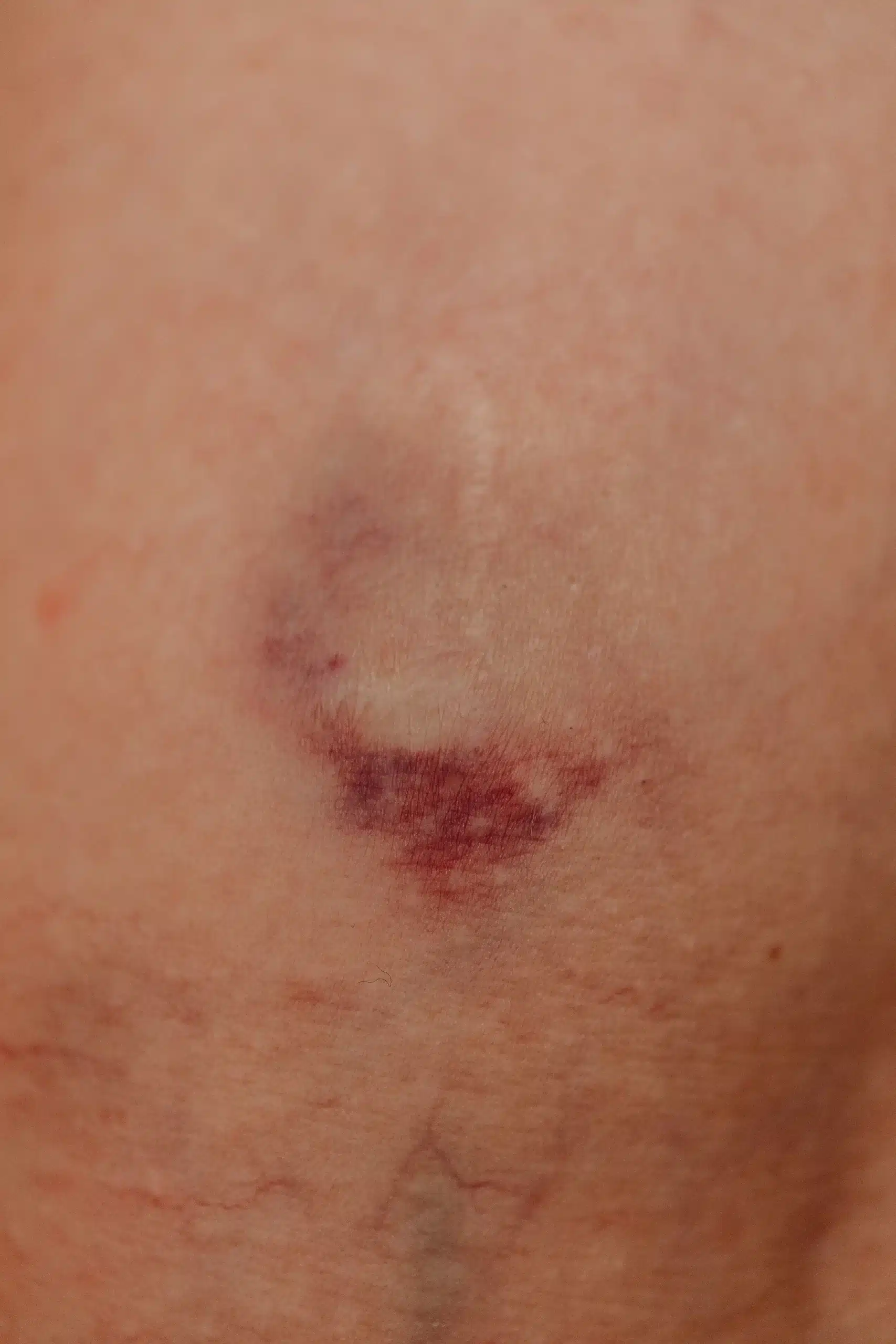
A bruise is caused by blood escaping from a damaged vessel; vascular occlusion means the tissue is not receiving enough oxygen-rich blood.
Some bruising, swelling and tenderness can be expected after an injection because the tissue and small blood vessels have been mechanically disturbed. However, in cases of vascular compromise, filler can obstruct blood flow. Intravascular embolism, vasospasm, or compression of blood vessels by the filler may reduce perfusion, causing pallor that can progress to a reticulated purple appearance and, in severe cases, tissue damage.
For us, the important distinction is whether the area is following an expected healing pattern or showing signs of impaired circulation. Colour alone cannot tell you that.

Normal post-procedure reactions tend to remain localised and gradually settle. We assess reactions according to the procedure performed, because recovery after an injectable treatment, cosmetic tattooing or a hydrafacial treatment shouldn’t automatically be interpreted in exactly the same way.
Typical uncomplicated reactions include:
Temporary swelling after a lip blush tattoo in Brisbane treatment or eyeliner tattoo in Brisbane procedure should be assessed according to cosmetic tattoo healing expectations, rather than automatically compared with filler-related vascular occlusion.
A bruise represents blood that has escaped into tissue. Vascular assessment asks a different question: is fresh blood adequately reaching that tissue? Swelling or dramatic bruising alone therefore does not establish vascular compromise.
Increasing pain, unexpected blanching or pallor, and mottled or livedoid skin changes are among the early signs that differ from typical post-treatment bruising. From a practitioner perspective, progression is particularly important. A reaction that is worsening or developing an abnormal vascular pattern deserves more attention than stable local tenderness.
Sudden, unusual or increasing pain deserves more attention than expected treatment-site tenderness. Clinical guidance identifies escalating pain at the injection site or along the affected vascular territory as abnormal, although local anaesthetic can mask it.
Pain is not always present during the early stages, so its absence cannot rule out vascular compromise.
Unexpected whitening or pallor can indicate reduced arterial perfusion. When arterial flow is obstructed, downstream tissue can blanch because less blood reaches the capillary network. Pallor may be brief or persistent before giving way to reticulated purple discolouration.
Knowledge of facial anatomy is important in medical aesthetics because filler injected at one location can affect tissue along connected vessels. The nose, glabellar region and forehead are identified as high-risk areas in CMAC guidance.
A developing mottled, lace-like or net-like pattern is more concerning than localised bruising. With ongoing hypoperfusion, pallor can progress to livedo reticularis, reflecting compromised circulation rather than simply blood leaking into the tissue. Progressive changes in skin colour are recognised markers of worsening tissue ischaemia.
The same procedure-specific distinction applies to saline tattoo removal in Brisbane treatments: expected redness or crusting should be interpreted in the context of that procedure rather than assumed to represent a filler-related vascular complication.

Capillary refill and tissue temperature provide useful information about circulation.
A capillary refill test measures how quickly colour returns after pressure temporarily empties superficial vessels. CMAC considers a capillary refill time of less than 2 seconds normal within its clinical assessment framework and recommends comparison with the corresponding unaffected side. In its protocol for an established vascular occlusion, persistent CRT above 3 seconds after intervention prompts reassessment and further treatment.
These figures should not be interpreted as a home diagnostic test. A result below 2 seconds does not prove that an occlusion is absent, while a result above 3 seconds does not independently diagnose one. Technique, baseline circulation and the overall clinical picture all affect interpretation.
Poor arterial perfusion can also make tissue cooler, making capillary refill just one part of a broader clinical assessment.
For practical guidance, we distinguish expected healing from warning signs by looking at the overall pattern rather than any single symptom.
| Feature | More Consistent With Normal Bruising/Swelling | More Concerning for Vascular Compromise |
| Pain | Expected local tenderness | Disproportionate or escalating pain |
| Colour | Red, blue or purple bruise | Pallor, livedo, dusky or grey changes |
| Pattern | Localised around treated tissue | Mottled, reticulated or vascular distribution |
| Capillary refill | Generally preserved | May be delayed |
| Temperature | Generally maintained | May become cooler |
| Progression | Stabilises and improves | Persists, spreads or deteriorates |
The table identifies warning patterns; no single feature can diagnose or rule out vascular occlusion.
When clients ask what are the stages of swelling healing, timing and progression matter because post-treatment changes can evolve over hours or days, and the important thing is whether symptoms are gradually settling or becoming more concerning.
A possible progression is:
blanching/pallor → livedo or mottling → dusky/grey tissue → tissue breakdown → tissue necrosis.
CMAC describes pallor and livedo as early stages, while continued hypoxia can progress to coagulative necrosis and devitalised tissue. Pallor or livedo does not, however, mean that necrosis is inevitable, particularly when vascular compromise is identified and managed promptly.
For us, the practical message matters more than predicting an exact timeline: skin necrosis and tissue death are late consequences of significant ischaemic injury, not signs to wait for before seeking assessment.


Not every vascular complication produces the same pale, painful appearance. Arterial compromise is associated with delayed capillary refill, whereas CMAC notes that brisk refill against a background of bluish skin may indicate venous compromise.
That overlap is why we would not classify an area as harmless bruising simply because it is purple. Distribution, progression, perfusion and the other clinical findings matter more than colour in isolation.
For us, patient safety takes priority over waiting to see whether a concerning change settles. Persistent blanching, rapidly increasing pain, expanding livedoid discolouration, unusually cool tissue, abnormal capillary refill or progressive grey/dusky colour warrant prompt professional assessment.
Visual and neurological symptoms are a separate emergency. Inadvertent intravascular injection of filler, most commonly hyaluronic acid, can enter the facial arterial circulation and cause vision loss through retrograde embolisation involving the ophthalmic artery circulation. A 2026 UK multidisciplinary consensus reports that filler-associated vision loss most often occurs immediately or within 10 minutes.
Among the published cases of filler-associated visual complications reviewed by the consensus authors, nearly 20% involved the central nervous system and exhibited stroke-like features. This percentage relates to reported cases of filler-induced visual loss; it is not the risk among all people receiving dermal filler.
Any new visual disturbance, vision loss or stroke-like symptom after filler injection requires immediate emergency medical assessment. The 2026 consensus recommends transfer to the closest emergency department without delay when ophthalmic or cerebrovascular involvement is suspected.
Questions such as can i get a cosmetic tattoo if i have an autoimmune condition also need individual assessment rather than being answered from one symptom, photograph or general rule:
Timing + progression + pain + colour change + capillary refill + temperature + vascular distribution.
A normal bruise can look dramatic while circulation remains intact. Early signs of impaired blood flow, by contrast, can be subtle; pain may be masked, and the full presentation can sometimes be delayed.
Injection technique, facial anatomy and the properties of hyaluronic acid fillers can all influence risk, but none can determine whether a new skin change is harmless. Facial ultrasound has a role in contemporary filler treatment, but suspected vascular compromise still requires proper clinical assessment.
If an area is getting worse rather than settling, contact the practitioner who treated you promptly. Vascular occlusion after dermal filler needs assessment by an appropriately trained healthcare professional.


Yes. Early vascular changes can resemble bruising, so we do not rely on colour alone. The pattern, blood flow, capillary refill, temperature, pain and progression need to be considered together.
No. Local anaesthetic can mask pain, so the absence of severe pain does not guarantee that circulation is normal.
It can appear immediately, but in some cases signs do not become apparent until hours or even days after dermal filler treatment.
Yes, but swelling is also normal after many aesthetic treatments. It becomes more concerning when accompanied by other warning signs such as abnormal pain, colour changes, temperature changes, abnormal capillary refill or progressive deterioration.
We recommend prompt assessment if an area becomes unusually pale, increasingly mottled or dusky, cooler, more painful or otherwise deteriorates. Any new visual disturbance or stroke-like symptoms after filler injection require immediate emergency medical care.
There is no single sunscreen restart time for every open-skin procedure. The FDA advises asking the treating provider about aftercare because microneedling may increase sensitivity to sunlight, sunscreen, makeup and moisturiser.
A similarly procedure-specific approach applies after an eyebrow tattoo in Brisbane treatment, where UV protection matters for both freshly treated skin and implanted pigment.
For clients wondering how can i achieve the glass skin finish in hot weather, protecting the skin barrier and managing UV exposure should come before chasing a glossy finish with extra products, especially while the skin is recovering from a procedure.
After a lip tattoo in Brisbane, aftercare should reflect the sensitivity and location of the treated area rather than generic facial skincare advice.
Once sunscreen is appropriate, choose a broad-spectrum product that protects against UVA and UVB radiation. Shade, protective clothing and avoiding unnecessary direct sun provide additional ways to reduce UV radiation exposure.