Can UV Change Tattoo Pigments, and Can They Be Corrected Without Laser?
Will skin pigments change colour over time with high UV exposure, and can they be corrected without resorting to aggressive laser removal? Yes, they can. Cosmetic tattoo pigments tend to fade and take on a different hue over time, with excessive sun exposure and UV radiation being major contributors to that change. But it’s not the only factor at play — the formulation of the pigment, where it’s implanted in the skin, how saturated it is, the client’s skin tone, and any previous touch-ups or treatments can all have an impact on how your eyebrow, lip or other cosmetic tattoo looks years down the line.
At Cosmetic Tattoo Studio Brisbane Face Figurati, getting the correction right starts with determining what’s left of the original pigment, where it is in the design, and whether the skin will tolerate further treatment. Sometimes that means getting rid of the leftover pigment entirely; other times just lightening it up a bit may do the trick.

Why Pigment Behaviour Changes Over Time
Cosmetic tattoo pigments do not necessarily fade as one uniform colour. Alongside questions about colour stability, clients often ask are the pigments reach compliant eu standards or tga listed, because formulation, manufacturing standards and the specific colourants used can all matter when assessing long-term pigment behaviour.
Scientific research supports the underlying mechanism. A systematic review of tattoo-pigment degradation found evidence that sunlight can cause photolysis — light-induced chemical breakdown — of tattoo pigments. Researchers identified only 11 relevant photolysis studies, however, so long-term colour behaviour is still not fully understood.
Fading Versus a Shift in Hue
Fading means the tattoo becomes less intense. A colour shift is different: its visible colour balance changes, potentially making brown pigment look warmer, redder, cooler, greyer, or more orange.
Differential degradation is one reason this can happen. If a cosmetic shade contains several colourants, they should not automatically be expected to fade at identical rates. That does not mean every brown brow will turn orange or every cool pigment will become grey; behaviour depends on the formulation, skin and treatment history.
How Skin Influences the Healed Result
A cosmetic tattoo may start as pigment sitting on the surface of your skin, but over time it becomes part of the living skin itself. So the natural melanin in your skin, your skin tone and undertones all start to influence the way we see the colour. This means that the factors to consider when we’re looking at old pigment are a lot more complex than you might think.
They include
- What kind of colourants were originally used
- Where and how deep the pigment is implanted
- Your natural skin colour and individual characteristics
- Any previous tattooing, touch-ups or colour boosts
- Skin ageing and general wear and tear
- Any other treatments that may have been done in the area
And the truth is, by itself, a red, orange, or grey hue can’t ever tell us exactly what pigment is left or why it ended up looking that way.

The Effect of Long-Term UV Exposure
UV rays are non-ionising radiation, and cumulative exposure can contribute to the photodegradation of tattoo pigments. Evidence supports photodegradation as a genuine mechanism, but not a simple formula linking a specific amount of UV exposure to a specific PMU colour shift.
Research specifically involving semi-permanent make-up remains limited. A 2026 systematic review included only 13 studies in its qualitative synthesis and found that SPMU pigments can be chemically complex mixtures. Universal predictions about how a particular cosmetic tattoo will age are therefore unreliable.
The Australian UV Environment
UV exposure warrants particular attention in Australia, as brows and lips are frequently exposed outdoors. ARPANSA explains that UV dose depends on both UV intensity and exposure time, making cumulative exposure important.
Australian guidance recommends sun-protection measures when the UV Index reaches 3 or above, including broad-spectrum, water-resistant SPF50 or higher sunscreen, protective clothing, shade, a hat and sunglasses.
Reducing unnecessary UV exposure once a cosmetic tattoo has fully healed is sensible, but it cannot guarantee that the pigment will remain exactly the same colour indefinitely.
Other Factors Behind an Unwanted Healed Colour
Pigment saturation, implantation technique, formulation, skin characteristics and previous work all matter when understanding what causes pigment migration and why an older cosmetic tattoo may no longer look the way it did originally. Repeated touch-ups deserve particular attention: adding more pigment to an already dense base presents a different correction challenge than working with a lightly faded tattoo.
Chemical peels and skin resurfacing procedures also interact with the skin in different ways and should not simply be described as “dissolving” cosmetic tattoo pigment. Treatment depth, skin barrier condition and healing all need to be considered.

Assessing Whether Existing Pigment Can Be Reworked
Sometimes, yes. Light, faded residual pigment that remains within a suitable shape may be amenable to colour neutralisation or corrective tattooing without complete removal.
Colour theory helps select the corrective direction. An excessively cool residual tone, for example, may require controlled warmth. Tattooed pigment does not behave exactly like wet paint, though: existing and newly implanted colours may sit at different depths and densities, so colour theory guides correction rather than guaranteeing a particular healed result.
When Adding Another Layer Is Not Appropriate
We are more cautious where pigment is:
- Very dark or densely saturated
- Built up through multiple previous treatments
- Outside the desired new shape
- Associated with visible skin changes that require further assessment
- Complex because previous correction or removal has altered the residual colour
This is where eyebrow tattoo removal or partial lightening may become relevant. Complete removal is not always necessary; sometimes the aim is simply to reduce enough unwanted pigment to create a better base for correction.
Choosing Between Neutralisation, Lightening and Removal
| Existing situation | Main concern | Potential approach | Why assessment matters |
| Light, faded pigment | Unwanted hue | Neutralisation/correction | Existing pigment may permit controlled correction |
| Faded pigment in a suitable shape | Colour and definition | Neutralise and refresh | The existing design may remain usable |
| Dark, saturated pigment | Excess pigment | Lighten before reworking | Adding more can increase saturation |
| Pigment outside the desired shape | Placement | Targeted lightening/removal | Neutralisation cannot change placement |
| Previously treated pigment | Complex residual colour | Staged assessment | Different hues may emerge after lightening |
There is no scientifically validated saturation percentage at which correction suddenly becomes impossible. These are assessment principles rather than universal clinical thresholds.
Less Intensive Ways to Reduce Existing Pigment
Avoiding complete laser tattoo removal does not necessarily mean avoiding removal altogether. For some tattoos, a more conservative approach may involve partial lightening, allowing time for healing, and reassessment before introducing new pigment.
For clients considering cosmetic tattoo removal in Brisbane, the useful distinction is not simply “laser versus non-laser”. The first question is whether the tattoo needs complete removal, selective lightening or no removal before correction.
Saline and Other Non-Laser Techniques
Saline and proprietary removal techniques are used in cosmetic tattooing. Saline tattoo removal in Brisbane is one non-laser option Brisbane clients may encounter when researching how to lighten old cosmetic tattoo pigment, but non-laser does not automatically mean it is gentler, safer, or scar-free.
High-quality comparative clinical evidence remains limited. Any technique intended to lighten implanted pigment interacts with the skin, so suitability, healing and appropriate post-treatment care matter.
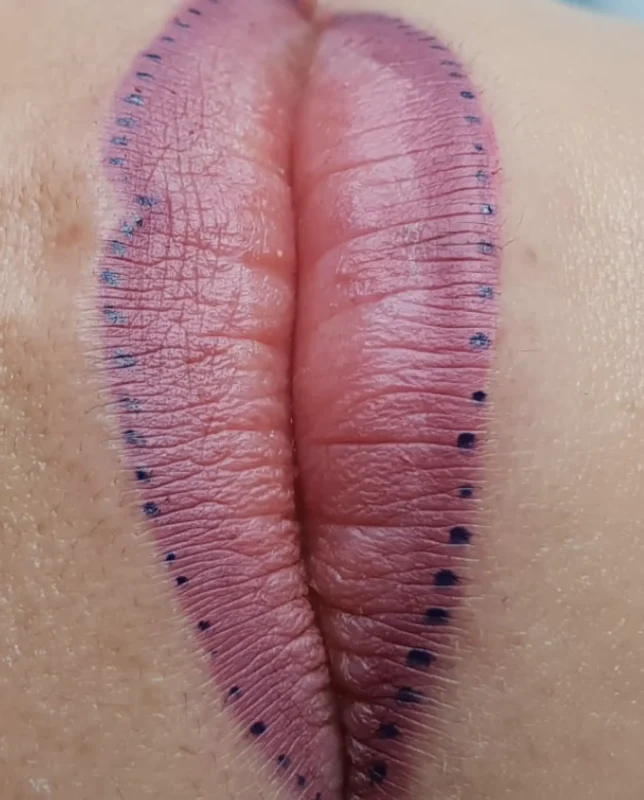
The same principle applies to lip tattoo removal: residual colour, pigment density, previous treatments and the condition of the treatment area all need to be considered before choosing between correction and lightening.
Where Laser Treatment Fits
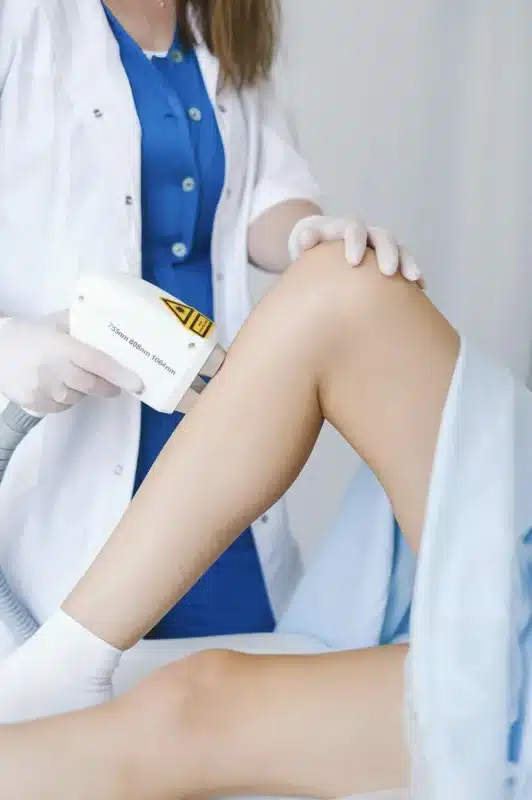
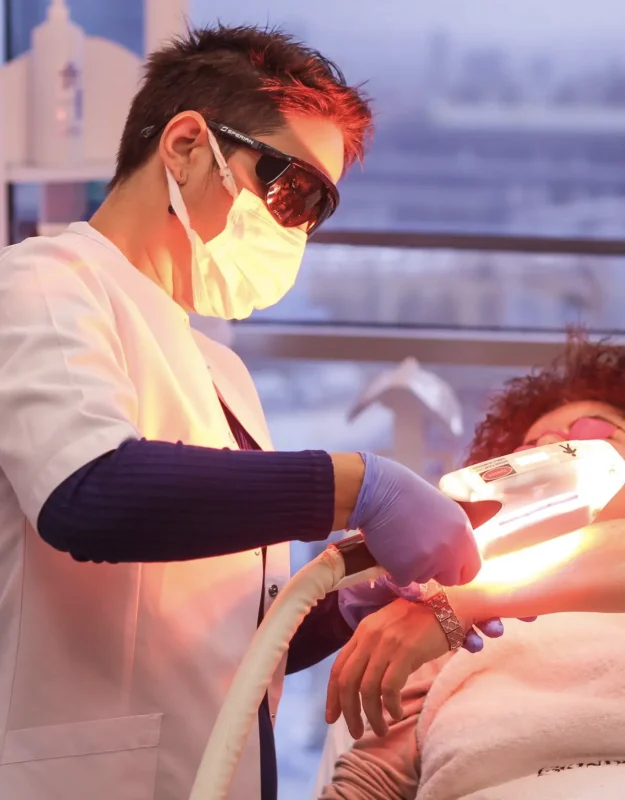
Laser removal should not automatically be treated as either necessary or something to avoid at all costs. Its suitability depends on the pigment and individual circumstances.
One particular consideration with cosmetic pigments is paradoxical darkening. Published medical literature has documented immediate darkening of some white, flesh-coloured, pink-red and cosmetic tattoo inks following short-pulsed laser exposure. This does not mean cosmetic tattoos cannot be treated with a laser; rather, an unknown cosmetic pigment should not be assumed to respond as conventional black tattoo ink does.


A Staged Approach to Complex Corrections
For more complex pigment, correction may need to happen in stages:
- Assess the healed colour, saturation, placement, skin and previous treatment history.
- Lighten if necessary rather than immediately adding another pigment layer.
- Allow the area to heal before reassessing what remains.
- Neutralise or redesign when the remaining base is suitable.
Lightening can reveal residual colours previously masked by darker pigment. For that reason, the final corrective colour or number of treatments cannot always be determined from the initial appearance alone.
Protecting the Healed Result From Further Fading
Once a cosmetic tattoo has fully healed, sensible sun protection helps reduce unnecessary cumulative UV exposure.
When the UV Index is 3 or above, Australian guidance recommends combining protection methods, including broad-spectrum, water-resistant SPF50+ sunscreen, rather than relying on sunscreen alone.
Maintenance should also follow the actual healed pigment. Adding colour at fixed intervals without considering existing saturation can make future correction more difficult.
Making the Treatment Decision
High UV exposure can definitely take a toll on your cosmetic tattoo, making it lose some of its vibrancy and look a bit faded. But for correction purposes, what really matters is the condition of the pigment that remains after all the sun exposure and other wear and tear.
At Face Figurati in Brisbane, we take a good, hard look at things like the remaining pigment, skin type and the look you’re going for before we decide whether we can just neutralise the colour, or if we need to do some lightening first. Our goal is to develop an approach that fits the situation.


FAQ
Can UV exposure turn brown cosmetic tattoo pigment orange or red?
UV radiation can, unfortunately, cause pigments to break down, and different colourants have varying levels of resistance to the sun’s rays. But, to be honest, there’s not much evidence to suggest that sun damage is going to turn every brown tattoo red or orange.
Can you fix grey or blue eyebrows without removing them entirely?
Sometimes, yeah. If there’s still some decent pigment there, and it’s in the right spot, we can usually just neutralise the colour and be done with it. But if the pigment is very dark or highly saturated, we might need to lighten it first.
Do you have to remove old cosmetic tattoo pigment completely before you can fix it?
No — not always. Some faded tattoos can be sorted straight out, while others might just need a bit of lightening. It’s only when the pigment has built up to a very high level or is badly placed that we need to consider removing it altogether.
Is non-laser tattoo removal safer than laser removal?
Well, not necessarily. The truth is, there’s no clear evidence that one is always safer than the other. What really matters is the type of pigment you’ve got, your skin type, the removal method, the person doing the treatment, and how well you recover, all of which have a big impact on the outcome.
Can you guarantee that the correction will restore the exact same pigment colour as before?
You can improve the colour, or balance it out so it looks a lot better, but there’s no promise it’ll be exactly the same as it was originally. After all, the remaining pigment, how saturated it is, your skin,n and any other treatments you’ve had in the past can all affect the final result.