

“What’s really in tattoo ink?” is a question we get asked almost every day in the studio & fair dinkum – you are sticking it into your skin for years after all. The simple answer is: tattoo ink is made up of pigment (that gives you the colour) and a carrier solution (that gets the pigment safely into your skin) – but the full story is a heck of a lot more complicated than that.
We’re Uliana Kasperksa and the team behind Cosmetic Tattoo Studio Brisbane Face Figurati – we’re certified cosmetic tattoo artists with over 15 years of hands-on experience across Europe and Brisbane. We do everything fromtattoos in Brisbane to advanced corrections – and let me tell you, we’ve seen some pretty dodgy tattoos in our time, as well as some that were done with some pretty dodgy pigment choices. So lets get down to it – no beating around the bush, no fear mongering or anything else – just the real story about what’s in tattoo ink.
Tattoo colours didn’t always look as good as they do these days. Old school tattooing used whatever natural materials were on hand – like burnt wood ash, charcoal and vegetable dyes. It was a bit rough around the edges – and definitely not exactly what we’d call safe by today’s standards.
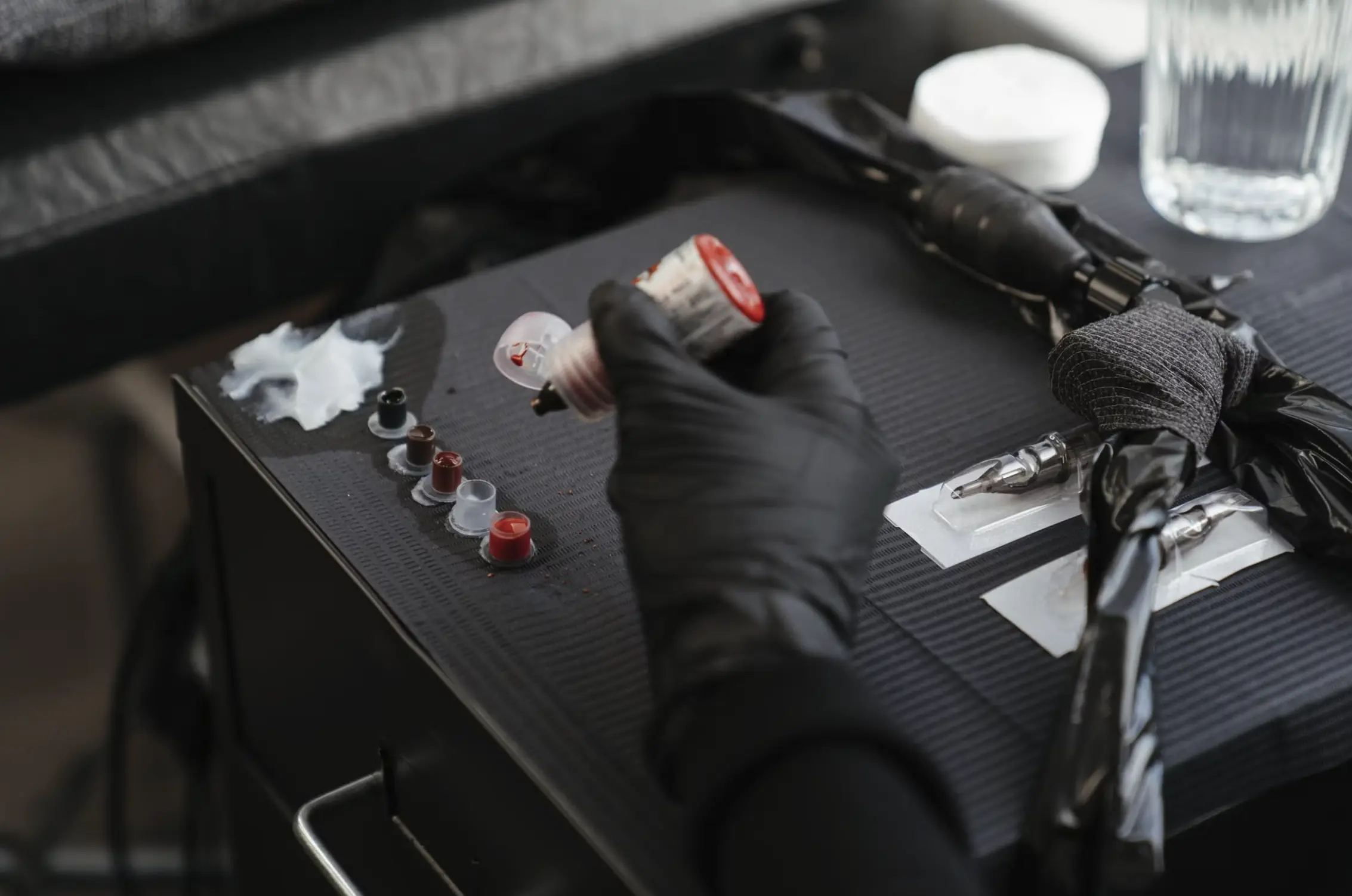
Nowadays, professional, proper tattoo pigments are developed in controlled labs and safety tested before they are used on anyone. That makes a big difference – the difference between not knowing what to expect when it heals and a result that actually ages well over time.
In Australia, we only use top-quality inks – no mixing our own, no using random mystery bottles. We know exactly what’s in them and how they’ll behave – because when it comes to putting ink into your skin, that’s not a game to be playing.

Professional tattoo colour systems are light years ahead of what most people would have guessed. They’re designed with a single-minded focus on keeping colours looking good for the long haul, without harming the skin.
Here’s what you can usually expect to find in the top-of-the-line products used by Brisbane tattoo artists:
Industry trends show that over 70% of pro studios worldwide now use sterile, one-off pigment systems (you can see this in the global tattoo industry reports from 2024 & 2025). That’s a huge improvement in how clean things are and just how safe those inks are for your skin.
We ditched our old formulas a few years back, to be honest. Why? Because we’ve seen just how badly they can hold up, especially in treatments like an eyebrow tattoo in Brisbane, where getting it just right is crucial.
Tattoo colour is made up of two key components, and understanding these helps you make smarter choices.
| Component | What It Does | Common Ingredients | Why It Matters |
|---|---|---|---|
| Pigment | Provides colour | Carbon black, metal oxides, organic pigments, and synthetic organic pigments | Determines colour, undertone, and long-term fade |
| Carrier | Suspends pigment and helps with application | Distilled water, ethyl alcohol, sterile carrier solutions | Affects flow, safety, and skin interaction |
Pigments determine what you actually see — but also how that colour behaves over time.
There are two main groups:
For example, most black inks use carbon black, known for its strong, deep tone. But even within black, quality varies. Poor formulations can shift cool or blue — something we often correct in older work.
Professional pigments are refined to reduce unwanted elements, such as heavy metals and unstable compounds associated with toxicological risks. That’s not marketing — that’s basic safety.
Carrier solutions make it possible for pigment to enter the skin smoothly during the tattoo process.
As a general rule, they contain:
If the carrier is off, it shows – and we’ve seen it time and time again in cases where people are getting saline tattoo removal – where the poor quality of the carrier played a big part.

Once the pigment is beneath the skin’s surface, your body gets to work breaking it down.
Some of it is held in place by skin cells, some of it gets gradually broken down and carried off through the lymphatic system, eventually making its way into the lymph nodes. And that’s why tattoos fade over time – it’s all about the way the body metabolises the pigment.
Fading isn’t a flaw – it’s just normal biology at work.
But the thing is, how it fades depends on a range of factors – like:
This is why, for a delicate piece of work like a lip tattoo in Brisbane, getting the pigment right is crucial – every shift is going to be noticeable.
Regulation in Australia exists, but it’s not as strict as many clients expect.
Pigments fall under:
Compared to the stricter European standard, ingredient control is less centralised.
So in the end, it’s down to the artist and the studio to make sure you’re working with the best stuff.
We only work with suppliers at Cosmetic Tattoo Studio Brisbane Face Figurati who meet top international standards. Because using poor-quality pigment can lead to all sorts of problems like allergic rashes, uneven healing and long-term dissatisfaction.
We had a client who came in with a brow job that had turned this weird grey-blue colour. At first glance, you might think it’s just normal fading – but under the right lighting, a very different story emerges.
The cause was clear:
Fixing it took a bit of work – we had to do multiple sessions and do some serious colour correction to get it right.
We see cases like that all the time from people who’ve had tattoos elsewhere – like eyeliner tattoos in Brisbane – and had to come back and get them fixed. And the common thread is that pigment choice is pretty much as important as the technique.


Brisbane’s weather changes how pigment behaves without a doubt. High UV levels break down colour much quicker than you might expect. Humidity also plays a role in how much oil is produced and how it heals. Plus your own lifestyle habits – going to the beach, hitting the gym, taking care of your skin – all affect how well the colour retains. That means we have to adjust our approach. The same pigment won’t behave the same way on every client – it’s as simple as that. It’s especially noticeable, though, in softer cosmetic tattooing work, where a bit of fading can make a big difference – much more so than just contrast.
Clients in 2026 are a lot more clued up – and a lot more cautious about what they put in and on their bodies, which is why questions about whether tattoos can lead to health issues come up so often during consultations.
We’ve been getting asked some tough questions like:
Not at all. Professional tattoo ink safety guidelines are all about keeping the bad stuff to a minimum.
That’s not necessarily the case. While many people use carbon black, it’s the formulation’s quality that really matters. Questions about what is the riskiest tattoo color usually come up when discussing black pigments, reds, and how different formulations behave over time.
Not true. Even if a product is labelled “organic” or “vegan”, its stability and performance depend on its formulation.
So far as we know, there’s no concrete evidence that this is the case, though as with all things, there’s ongoing research into the long-term effects.
Tattoo colour is way more than just “ink”. It’s a combination of what you’re using, how the artist does the work and how it all interacts with your body over time. The outcome depends on:
At cosmetic tattoo studio in Brisbane, we focus on using pigments that heal cleanly and look good for a long time.


Since 2016, Anastasia has worked in the professional tattoo industry in Brisbane, developing extensive knowledge of the pigments and materials used in modern tattooing procedures. As a certified and licensed specialist with qualifications across Europe and Australia, she focuses on safe pigment selection, skin compatibility, and long-term treatment outcomes.
Her approach considers pigment composition, colour stability, and how different ingredients interact with various skin types over time. By carefully selecting high-quality pigments and tailoring treatments to each client, she helps ensure results that are safe, balanced, and designed to age predictably.
Most people have no issues, but some people might be more sensitive. Always have a chat about any allergies you might have, and consider getting a patch test.
Some of the pigment hangs around forever, while the rest is processed by your lymphatic system over time.
Most of the time, it’s carbon black, though sometimes we mix it with some additional stuff to get the right consistency.
Well, sometimes methods like saline brow tattoo removal or laser treatment can help reduce the pigment, but the results are always a bit hit-and-miss.
There are trace amounts of heavy metals in some formulations, but any product we use has to meet safety guidelines and is designed to be as safe as possible.